GDPR Compliance and Cookie Consent in 2026: 7 Checks That Keep the Story Honest
A useful guide to gdpr compliance & cookie consent should help readers understand both the rule and the behavior behind the rule. That is where consent topics become genuinely practical instead of sounding like recycled compliance copy.
The linked DataShyre articles cover the nearby topics, while this explainer should stay focused on plain-English direction for publishers, operators, and marketers.
That is the right frame now because the official guidance is still pushing in the same direction. The European Commission still says valid consent must be specific, informed, affirmative, and presented in “clear and plain language.” The UK’s ICO finalized its storage-and-access-technologies guidance on April 29, 2026 and made clear the review reaches beyond classic cookies to scripts, tags, pixels, fingerprinting, and similar tools. On March 19, 2026, the EDPB launched a coordinated enforcement action focused on transparency and information obligations under Articles 12, 13, and 14 GDPR. And CNIL’s current banner enforcement message is still blunt: “rejecting cookies should be just as easy as accepting them.”
If you want the adjacent implementation detail first, start with these guides to cookie consent, GDPR consent requirements, and cookie consent banner. This article is narrower. It is the seven-check review I would use this week before telling a team their gdpr compliance & cookie consent setup is ready.
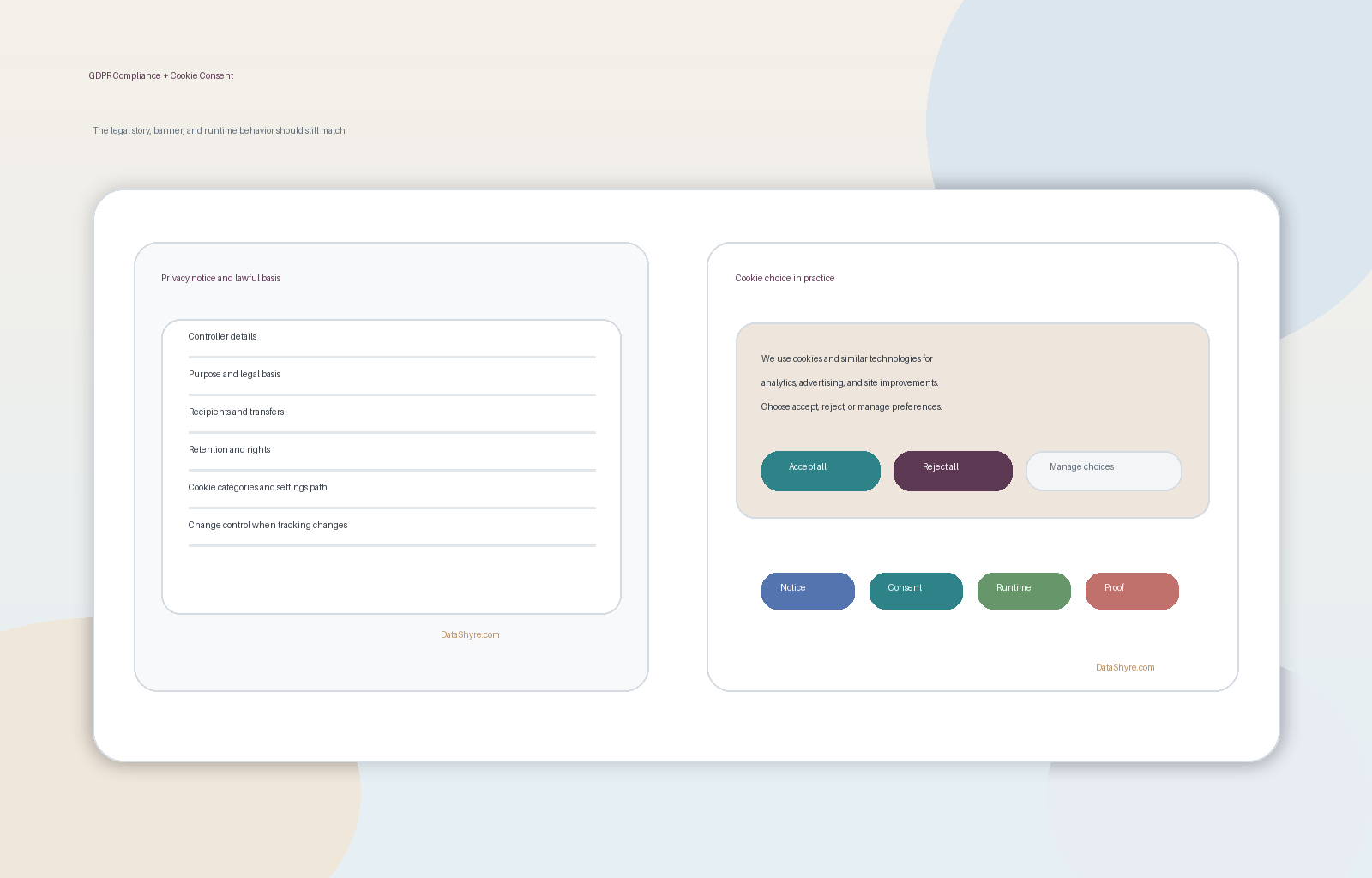
1. Stop treating cookie consent as the whole GDPR program
Cookie consent matters, but it is only one part of GDPR compliance.
The European Commission’s obligations guidance still says people must be told who is processing their data, why, on what legal basis, for how long, who receives it, and what rights they have. So even a technically solid cookie banner can sit inside a weak overall privacy setup if the notice is vague, the legal basis mapping is sloppy, or the data flows described to users no longer match the real product.
That means the first review question is simple: does the cookie layer fit the broader data-protection story, or is it being used to hide gaps elsewhere?
If the banner says one thing while the privacy notice, form copy, or downstream use says something else, the problem is larger than banner design.
2. Make the first layer fair enough to support valid consent
This is still the fastest way to rule weak setups out.
The Commission’s consent guidance says the request must be visible and written in “clear and plain language.” It also says withdrawal must be “as easy to use as giving consent.” CNIL’s formal notice on dark patterns adds the practical interface test many teams still need: “rejecting cookies should be just as easy as accepting them.”
For a real website review, that means checking whether:
Reject allis present whereverAccept allis present;- the optional purposes are named plainly enough for a normal user to follow;
- mobile layouts do not bury refusal or customization;
- the banner does not imply that browsing alone counts as consent.
If the privacy-protective path is dimmer, slower, or harder to find, the gdpr compliance & cookie consent story is already under strain before deeper testing starts.
3. Map the actual technologies and purposes before you talk about compliance
A lot of teams review banners before they review the stack.
The ICO’s 2026 guidance is useful because it broadens the practical scope. Its storage-and-access-technologies material says the rules can apply to scripts and tags that store or access information on a user’s device, not only to classic named cookies. That matters because many weak implementations still focus on cookie tables while ignoring video embeds, chat widgets, A/B testing tools, pixels, session replay tools, or custom JavaScript that touches the device before a real choice exists.
So before sign-off, build a simple map:
- which technologies are strictly necessary;
- which ones support analytics, advertising, personalization, or testing;
- which legal or consent path each one relies on; and
- which notice, category, or purpose label the user sees for it.
If you cannot map the live technology to the user-facing explanation, you are not really reviewing gdpr compliance & cookie consent yet. You are reviewing design copy in isolation.
4. Test runtime behavior before choice, after choice, and after withdrawal
This is where a compliant-looking deployment most often breaks.
The ICO’s current guidance still says users must be clearly informed before they consent and that your mechanism should let them reject non-exempt technologies as easily as they accept them. It also says that if you introduce a new technology or a different purpose from the one originally stated, you must obtain fresh consent for that new technology or purpose.
So do not stop at screenshots. Open a clean session and test:
- what loads before any action;
- what changes after
Reject all; - what changes after a granular approval;
- what changes after the user later withdraws.
The banner is only credible if the runtime follows it. If optional technologies still fire too early, or if withdrawal changes the interface but not the underlying behavior, the setup is not strong enough to carry the gdpr compliance & cookie consent claim.
5. Make sure the privacy notice and the cookie layer tell the same story
This is where many sites quietly drift.
The Commission’s obligations guidance and the ICO’s right-to-be-informed guidance both still point to the same basic requirement: people need concise, intelligible, accessible information about the processing that actually happens. The ICO also says that if you plan to use personal data for new purposes, you must update the privacy information and proactively bring changes to people’s attention.
That creates a practical test:
- does the cookie banner describe the same purposes the notice describes;
- do the notice and the settings panel use compatible labels;
- do retention, recipients, transfers, and rights language still reflect the live stack;
- has the team updated the notice when a new tracker, embed, or ad-tech purpose was added.
This is one reason the 2026 EDPB coordinated enforcement focus matters. Transparency is not only a policy-page issue. It is about whether the user-facing explanation still matches the processing model the site is actually running.
6. Make withdrawal and later control real, not ceremonial
A lot of banners are built around collection and barely tested for reversal.
The Commission still says consent must be withdrawable in a way that is as easy as giving it. The same practical logic appears across regulator materials: if the person can accept in one click but has to hunt through a footer maze, account portal, or support form to reverse the choice, the system is over-crediting its own compliance.
For gdpr compliance & cookie consent, I would want to verify:
- a persistent path back to settings;
- same-session preference updates that actually change live behavior;
- a clean return experience on the next visit;
- a process for re-consent when the purpose or technology changes.
Withdrawal is where the stack proves whether it is managing consent or only collecting it.
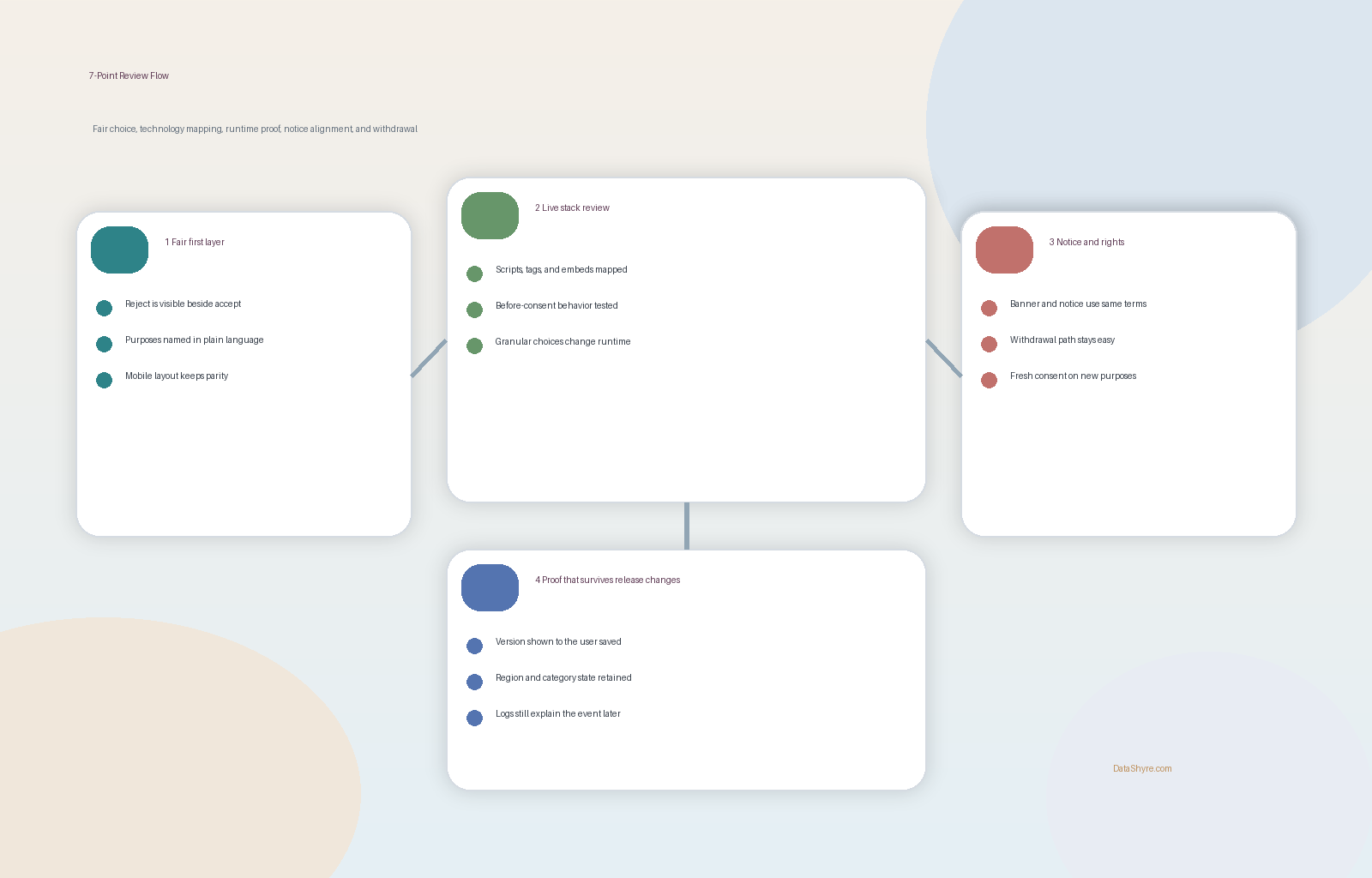
7. Keep evidence that another team can understand later
The final check is boring, but it is usually the one that survives scrutiny.
The broader GDPR transparency obligations and the practical consent guidance both point toward records that explain what happened, not just a yes-or-no flag. And because the EDPB’s 2026 coordinated action is focused on transparency and information obligations, teams should expect closer attention to what people were told and whether that explanation stayed aligned with the implementation.
For a durable record, keep enough evidence to answer:
- what banner or notice version the person saw;
- what categories or purposes were offered;
- what choice they made, when, and in which region or ruleset;
- what technologies were governed by that choice;
- what changed later if the person withdrew or if the site changed.
If legal, engineering, marketing, and support would all read the same record differently, the proof layer is thinner than it looks.
A short review order for this week
If I were auditing gdpr compliance & cookie consent today, I would do it in this order:
- compare the first-layer accept and reject paths on desktop and mobile;
- list the real technologies and purposes behind each category;
- inspect what fires before any click on your highest-risk pages;
- compare the banner, settings layer, and privacy notice for drift;
- test withdrawal and return-visit behavior;
- check whether new technologies or purposes would trigger fresh consent;
- review whether the stored evidence still explains the full story.
That sequence usually reveals more than another copy review or design tweak.
Bottom line
The best gdpr compliance & cookie consent setups in 2026 are not the ones with the most polished banner.
Seen clearly, gdpr compliance & cookie consent is less about a pop-up and more about whether the site behaves honestly after the visitor makes a choice.
Sources
- European Commission, legal grounds for processing data: https://commission.europa.eu/law/law-topic/data-protection/information-business-and-organisations/legal-grounds-processing-data_en
- European Commission, obligations of companies and organisations: https://commission.europa.eu/law/law-topic/data-protection/information-business-and-organisations/obligations_en
- ICO, final storage and access technologies guidance published: https://ico.org.uk/about-the-ico/media-centre/news-and-blogs/2026/04/final-storage-and-access-technologies-guidance-published/
- ICO, guidance on the use of storage and access technologies: https://ico.org.uk/for-organisations/direct-marketing-and-privacy-and-electronic-communications/guidance-on-the-use-of-storage-and-access-technologies/
- ICO, how do we manage consent in practice?: https://ico.org.uk/for-organisations/direct-marketing-and-privacy-and-electronic-communications/guidance-on-the-use-of-storage-and-access-technologies/how-do-we-manage-consent-in-practice/
- ICO, right to be informed: https://ico.org.uk/for-organisations/uk-gdpr-guidance-and-resources/individual-rights/individual-rights/right-to-be-informed/
- EDPB, CEF 2026 on transparency and information obligations: https://www.edpb.europa.eu/news/cef-2026-edpb-launches-coordinated-enforcement-action-on-transparency-and-information_en
- EDPB, Belgian DPA must handle the merits of NOYB cookie banner complaint: https://www.edpb.europa.eu/news/edpb-requires-belgian-dpa-to-handle-the-merits-of-noyb-cookie-banner-complaint_ga
- CNIL, dark patterns in cookie banners: https://www.cnil.fr/en/dark-patterns-cookie-banners-cnil-issues-formal-notice-website-publishers
—
Published: October 22, 2026. Updated using current official regulator and government materials available at publication time.